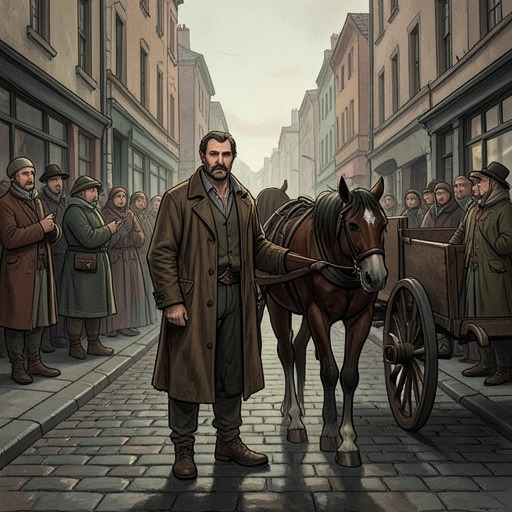
Jerry Takes a Sick Child to the Hospital for Free
Black BeautyJerry Barker’s free ride to St Thomas' Hospital turns a brief encounter in a crowded London street into a practical test of his principles: faced with a sick child, a mother who cannot afford a cab, and passengers demanding the vehicle, he makes room for the people who most need his help. The episode also shows how his compassion takes the form of decisive action rather than sentiment alone.
The Mother’s Request
The incident occurs during an election, when crowded streets and cabs displaying candidates’ colors make travel difficult. Jerry and Black Beauty have paused to eat when a young woman approaches, carrying a heavy child and looking for directions. She has come from the country that morning in a market cart, does not know London, and has an order for her son to be admitted to St Thomas' Hospital. The four-year-old is in pain, cannot walk, and gives a weak, distressed cry.
The hospital is three miles away. Jerry points out that the woman would have to carry the child through the crowds, where they could be knocked down or run over. She says she is strong enough to walk if only she can find the way, but explains that she has just enough money to return home. Her answer makes the choice concrete: she needs the ride, but cannot pay for it.
Jerry Keeps the Cab for Her
Jerry offers to drive them safely to the hospital without charge. He explains his decision through his own family life: he has a wife and children and understands a father’s concern for a child. He also says he would be ashamed to let the woman and boy face the danger of walking through the crowd. His response converts sympathy into a specific commitment—he will use his cab, time, and working horse to get them to medical care.
Before he can help the woman into the cab, two men wearing election colors hurry up and claim it. They push past her, get inside, and insist that their business is important and that they have the right to stay. Jerry does not abandon his promise or try to dislodge them by force. He tells them the cab is already engaged by the woman, then closes the door and calmly invites them to remain as long as they like. The ruse makes clear that they cannot have the ride they came for; once they understand it, they get out, complain, and threaten to report Jerry. Their interruption costs time, but it does not change his decision about whom the cab is for.
The Journey and Its Aftermath
With the obstruction over, Jerry takes the woman and her son to the hospital, using side streets as much as possible. He rings the great bell and helps her out. She thanks him, saying she could not have made the journey alone, and he wishes the child a recovery. Jerry waits until she has gone inside before turning back to the cab. The episode ends its central act of help not at the moment of arrival, but when he has seen that the mother and boy have reached the hospital door.
As Jerry and Black Beauty are leaving, the hospital door opens again and a porter calls for a cab. A woman comes out, recognizes Jerry, and addresses him by his full name, Jeremiah Barker. She says she is glad to find him and asks him to take her to Paddington Station; if they have time, she wants to hear about Mary and the children. This brief encounter reveals that Jerry is known to her beyond the immediate hospital scene, and it places his public kindness alongside a continuing personal life. The story does not identify the woman further here, so the meeting establishes familiarity without explaining its history.
Charity and Responsibility
The hospital ride belongs to a larger pattern in Jerry’s conduct. Elsewhere he refuses a proposed regular Sunday fare to church because his six-day cab license does not permit him to work that day. He also speaks in favor of intervening when someone sees cruelty or wrongdoing that can be stopped. In the hospital episode, that conviction is expressed through a smaller, immediate decision: the mother’s lack of money does not become a reason to leave her and the child to face a hazardous walk.
The account also distinguishes Jerry’s circumstances from the pressures placed on many cab drivers and horses. He owns his cab and is described as having a personal interest in treating Black Beauty well and not overworking him. By contrast, drivers who rent cabs and horses may have to earn a substantial daily charge before taking anything home, while regulated fares and heavy workloads press down on both driver and animal. The free journey therefore takes place within a working world where time and fares matter, even though the narrative does not specify what Jerry loses by making this particular trip.
Black Beauty’s narration makes the horse part of the scene’s moral perspective: the cab is not an abstract service but a working partnership carrying its owner’s choice into action. Jerry’s gesture is significant not because it removes the wider dangers of the city or the hardships of cab work, but because, for this mother and child, it changes what is possible. The cab that election-goers try to claim becomes a safe way to reach care, and Jerry’s kindness is measured by the distance he actually takes them.